
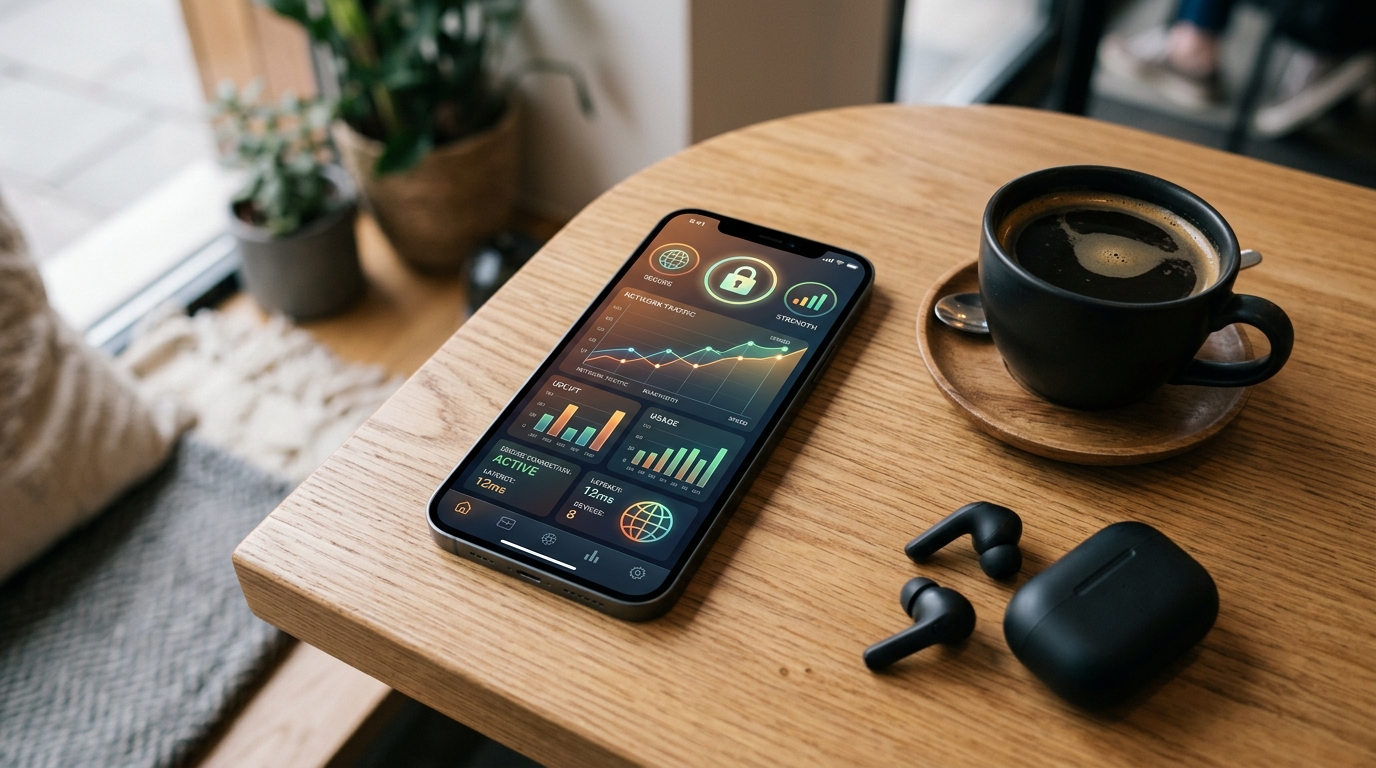
Imagine logging onto a public wireless internet network at a busy airport terminal. You carefully open a secure private browser to check your bank balance, feeling reasonably protected. Meanwhile, quietly in the background, your weather app, email client, and social media feeds are silently syncing data over an unencrypted connection, potentially exposing your location and device identifiers to network sniffers. This dangerous gap between perceived security and actual vulnerability is exactly why user habits are rapidly changing in 2026.
True mobile privacy requires moving beyond isolated tools to a unified network that encrypts traffic, handles DNS routing, and blocks background trackers system-wide without draining your battery. As a digital identity researcher specializing in verification services, I often see how identity theft starts with these small data leaks. I recently spent time analyzing the feedback from our latest app milestone—surpassing a quarter-million active sessions. The data presents a stark reality: people are no longer willing to sacrifice device performance for theoretical security. They want immediate, system-wide results.
Speed dictates privacy tool retention
There is a massive disconnect between how engineers design security tools and how everyday people use them. When users search for a "vpn free iphone" solution or test out a basic free vpn, their primary concern is rarely the cryptographic strength of the tunneling protocol. Their main concern is performance.
Recent data underscores this performance mandate. According to a 2026 report by industry analysts analyzing mobile app trends, 70% of users will delete a slow application immediately after their first use. If a privacy app delays a webpage load by even two seconds, it is quickly abandoned. People often cycle through apps like potato vpn, super vpn, or x vpn, only to uninstall them when their home wifi connection suddenly crawls to a halt.
When we analyzed our retention milestone, we saw that users stick with a tool only when the underlying infrastructure feels invisible. If the network routing causes your subscription video on demand (SVOD) service to buffer, the tool has failed its primary usability test.

Streaming habits demand stable wireless internet connectivity
Network stability is no longer just a luxury; it is a baseline requirement for modern digital consumption. To understand why fragmented privacy setups fail, we have to look at how much media we consume. Deloitte’s 2026 Digital Media Trends research reveals that highly engaged digital consumers spend 51 more minutes—a 16% increase—with media and entertainment daily compared to average users. Furthermore, 92% of these users adopt SVOD services, demanding high-bandwidth, uninterrupted streams.
When you attempt to route this heavy media consumption through a legacy vpn, the bottlenecks become obvious. Traditional routing methods often struggle with adaptive streaming, leading to constant buffering. In contrast, modern setups utilizing efficient protocols like wireguard manage data packets much more effectively, ensuring that whether you are on home wifi or an unstable public network, your connection remains fluid. Users transitioning from older setups like hotspot shield or pia vpn frequently cite this specific bandwidth stability as their primary reason for migrating to modern alternatives.
Standalone browsers leave background traffic exposed
A crucial realization from our user data is the widespread misunderstanding of what a browser actually protects. We see thousands of support tickets from users who previously relied on a specialized private browser—such as brave, aloha, or opera gx—believing their entire device was secure.
Here is the comparison insight that changes how we view mobile security: A secure browser only encrypts the traffic occurring within that specific app. It acts as an isolated sandbox. If you use opera or another specialized browser, your web searches are protected, but the moment you minimize the app, your background processes are entirely exposed. Your fitness tracker, your background email sync, and your background location services are still transmitting data in the clear.
In contrast, a system-wide virtual private network creates a protective tunnel for the entire device. Rather than relying on piecemeal protection, all data leaving the phone is encrypted. As my colleague Yiğit Özdemir explained in a recent internal review regarding our earlier 100,000 user milestone, everyday browsing habits show that users suffer from "DNS fatigue" when forced to configure multiple apps to achieve what one system-level tool should handle automatically.
Unified infrastructure outperforms fragmented security applications
For a long time, the advice for tech-savvy users was to build a customized stack: use proton vpn for routing, install a standalone ad blocker, and configure 1 1 1 1 manually for faster DNS lookups. While effective in theory, this fragmented approach is often a disaster for mobile battery life and RAM management.
Comparing a fragmented setup to a unified application reveals several critical differences:
- Resource Management: Running three different background apps constantly fighting for network permissions drains mobile batteries significantly faster than a single optimized app.
- Conflict Resolution: Standalone ad blockers often conflict with generic tunneling apps, resulting in broken webpages or dropped connections.
- Simplicity: Everyday users—from students to freelancers—do not want to act as network administrators. They want a single toggle switch.
This is where context matters. If you want comprehensive protection without the administrative headache, VPN 111: Warp IP DNS Changer's unified infrastructure is designed for exactly that. It serves as a VPN, DNS changer, and ad blocker in one streamlined app, eliminating the need to stack multiple resource-heavy applications. By consolidating these features, the app ensures that background trackers are stopped at the network level before they even load, saving both bandwidth and battery life.

Enterprise concepts are shaping consumer expectations
Interestingly, the expectations of everyday mobile users are slowly mirroring enterprise security architectures. In the corporate world, IT administrators use specialized tools for network monitoring or deploy SASE (Secure Access Service Edge) frameworks to ensure remote workers connect securely. While a standard user doesn't need to configure a complex architecture for their personal smartphone, they now expect that same level of always-on security.
Our milestone data confirms that the era of manually turning a tool on and off is ending. Users expect their privacy app to intelligently manage network handoffs—transitioning from a secure home connection to an untrusted coffee shop network without dropping the active session. This shift aligns with recent Adjust 2026 data indicating that smart automation is transitioning from a strategic add-on to core infrastructure in mobile applications. Modern privacy tools must dynamically adapt to network conditions rather than waiting for manual user input.
Simplifying the decision framework for mobile privacy
With so many options available, from nord vpn to express vpn, choosing the right tool can feel overwhelming. Through analyzing hundreds of thousands of user sessions, we've developed a straightforward decision framework for evaluating mobile privacy tools:
First, identify your core requirement. If your only goal is to bypass a regional restriction for a single web search, a quick web proxy or a generic search for "von" (a common typo) might yield a temporary fix. However, this is NOT for users who conduct banking, send sensitive emails, or want to block intrusive ads across all their apps.
Second, evaluate the ad-blocking integration. Does the tool merely hide your IP, or does it actively filter malicious domains at the DNS level? A built-in ad blocker improves page load times by preventing heavy tracking scripts from downloading in the first place.
Finally, look at the ecosystem. Reliable infrastructure often stems from experienced mobile app companies. For instance, Verity builds dependable mobile applications, ensuring that whether you are using their communication tools or securing your connection, the underlying architecture is stable and built for scale.
The biggest lesson from analyzing 250,000 users is that complex privacy solutions are ultimately self-defeating. If a tool requires constant monitoring or slows down your device, it will eventually be disabled. By shifting from fragmented browsers to unified, system-wide network protection, you secure your entire digital footprint without compromising the speed and performance you rely on daily.